


You're in a parking lot with a sleeping newborn, a car seat in one hand, and a folded stroller taking up the other. The baby finally settled, but now you have to wake them, transfer them, and assemble your outing before you've even reached the sidewalk. That's the exact problem a travel system stroller is designed to solve.
The pros and cons of travel system strollers come down to one central trade-off: click-and-go newborn convenience versus bulk, weight, and limited long-term flexibility. If you drive often and make frequent car-to-stroller transitions, the bundle can make daily life noticeably simpler. If you rely on transit, climb stairs, fly often, or need the smallest possible fold, it may frustrate you.
Before you shop, decide where the stroller will live, how often it will leave the car, and what you'll use after the infant car seat is outgrown. If a coordinated setup fits your routine, explore travel system options from NINI and LOLI and compare the folded size, car-seat fit, and toddler-stage plan before buying.
| Factor | Travel system | Modular frame | Separate stroller and car seat |
|---|---|---|---|
| Newborn transfers | Fast, coordinated click-in use | Flexible, depending on components | Requires carrying or transferring the baby |
| Compatibility | Usually built into the bundle | Must be checked across components | Must be checked carefully |
| Everyday weight | Often heavier | Varies by configuration | Can be lighter for stroller use |
| Storage | Larger footprint is common | Configuration-dependent | Often easier to split between car and home |
| Long-term flexibility | Depends on toddler-seat design | Usually high | High, but requires more planning |
| Best fit | Frequent driving and errands | Growing families planning ahead | Tight storage, frequent flights, or transit |
What a Travel System Stroller Really Is
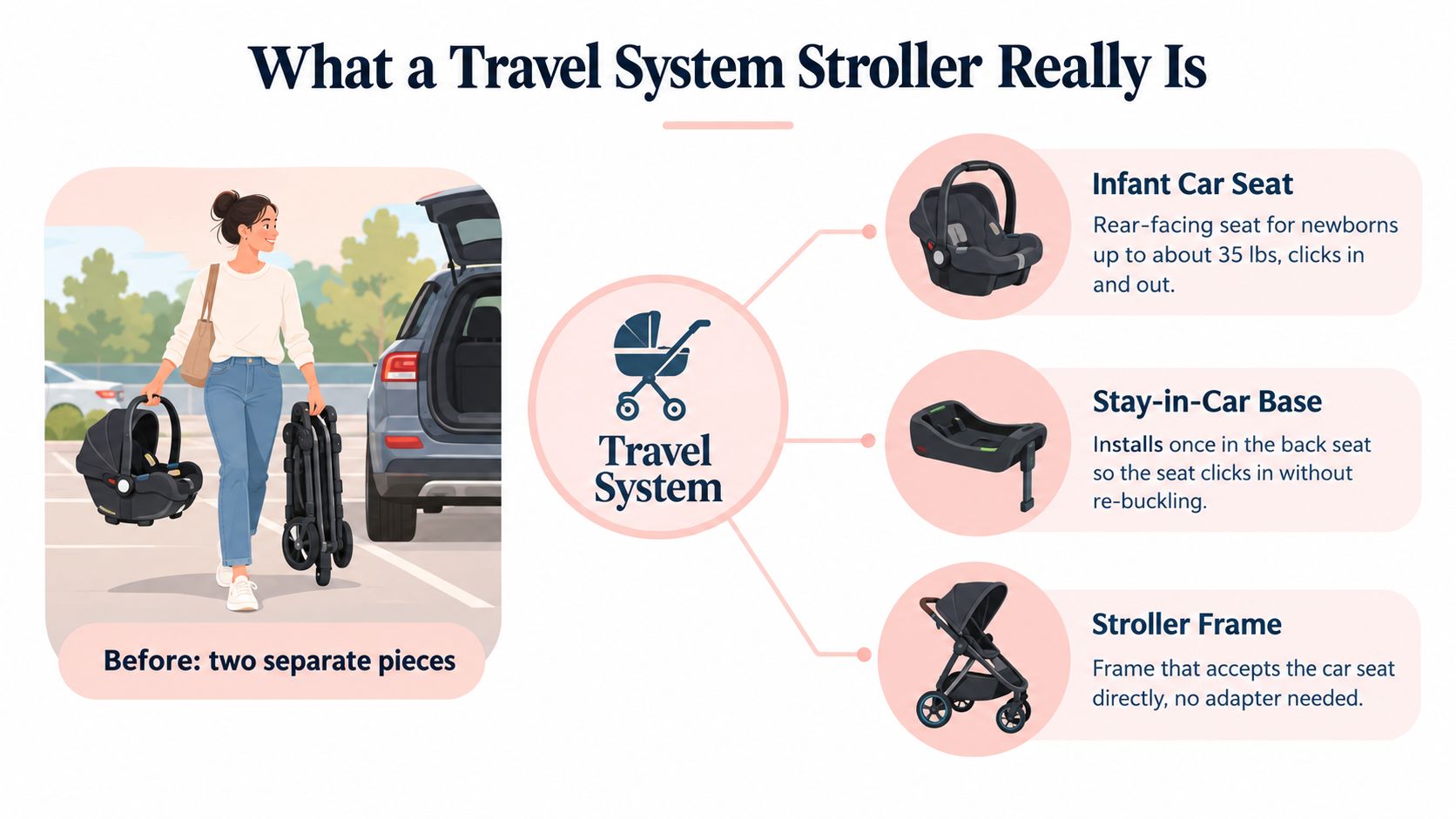
A travel system stroller is a coordinated mobility setup that combines an infant car seat, a stay-in-car base, and a stroller frame designed to work together. The infant seat is rear-facing and lifts out of its base, while the stroller accepts that same carrier directly, usually without a separate adapter. The result is one connected system for moving a baby from the vehicle to the stroller.
The box typically includes the infant car seat and stroller, and many bundles include the car-seat base. Accessories such as cup holders, rain covers, extra bases, or additional adapters may be sold separately, so read the package contents rather than assuming every pictured item is included.
The design solves a specific newborn problem. Instead of unbuckling a baby from the car seat and placing them into a stroller seat, you release the carrier, lift it, and dock it onto the frame. That's why a travel system differs from a standalone stroller. A standalone stroller is purchased as a pushchair on its own, and it may require a compatible infant-seat adapter if you want to use it with a car seat.
How the pieces work together
- Install the base in the vehicle. The base stays secured in the back seat according to the car-seat and vehicle instructions.
- Click the infant carrier into the base. The carrier releases when you reach your destination.
- Attach the carrier to the stroller frame. The stroller interface holds the compatible infant seat in place.
- Use the stroller seat later. Many systems continue into toddlerhood, but the exact configuration and limits depend on the model.
Some systems are brand-matched, meaning the components are engineered and sold as one pairing. Others use a stroller with a separately selected infant seat and a specific adapter. In either case, “travel system” describes the coordinated setup, not one universal product design. Read this guide to what a travel system stroller is before assuming any infant car seat will fit any frame.
The Real Benefits Parents Notice Day to Day
The strongest benefit is simple: you can move a sleeping baby without unbuckling them from the infant carrier. That matters after a pediatrician visit, when the baby has finally fallen asleep in the car, or during a daycare drop-off when you need to get from the parking space to the door without starting the whole routine again.
Consumer Reports describes the integrated car-seat connection as the core advantage of a travel system, while also warning that pushing the stroller and car seat together can make the setup bulky, especially on stairs. Its overview of travel-system convenience and trade-offs captures the daily calculation well. You're buying fewer transfers, not a weightless stroller.
Convenience that earns its space
A bundled system also removes one early purchasing decision. The infant seat and stroller are designed to connect, so you don't have to begin by investigating adapters and hoping two independently chosen products will cooperate. That can be valuable when you're preparing for a newborn and already have a long list of equipment to sort through.
The routine becomes especially smooth for families who:
- Drive to most outings: The stroller frame can stay in the trunk while the carrier remains with the baby.
- Share drop-offs: Different caregivers can follow the same attachment and release process.
- Make short errands: A quick grocery stop or pharmacy visit doesn't require rebuilding the setup.
- Move between indoor and outdoor spaces: The carrier can go from the car to a compatible frame with little handling.
Parents often appreciate having fewer loose parts in the trunk, too. A coordinated release button, docking point, and stroller fold are easier to learn than several unrelated mechanisms. That doesn't make every system easy, but it can make the first months feel less chaotic.
The emotional payoff is real
Newborn outings already ask a lot of you. Keeping the baby settled while you unload groceries, enter a clinic, or bring the stroller inside can feel like a small victory. A travel system earns its keep when it prevents repeated transfers during the stage when the infant carrier is genuinely useful.
For more guidance on matching stroller features to your routine, use this practical stroller selection guide. Focus on the errands you'll repeat, not the features you may use once.
Honest Downsides Worth Knowing Before You Buy
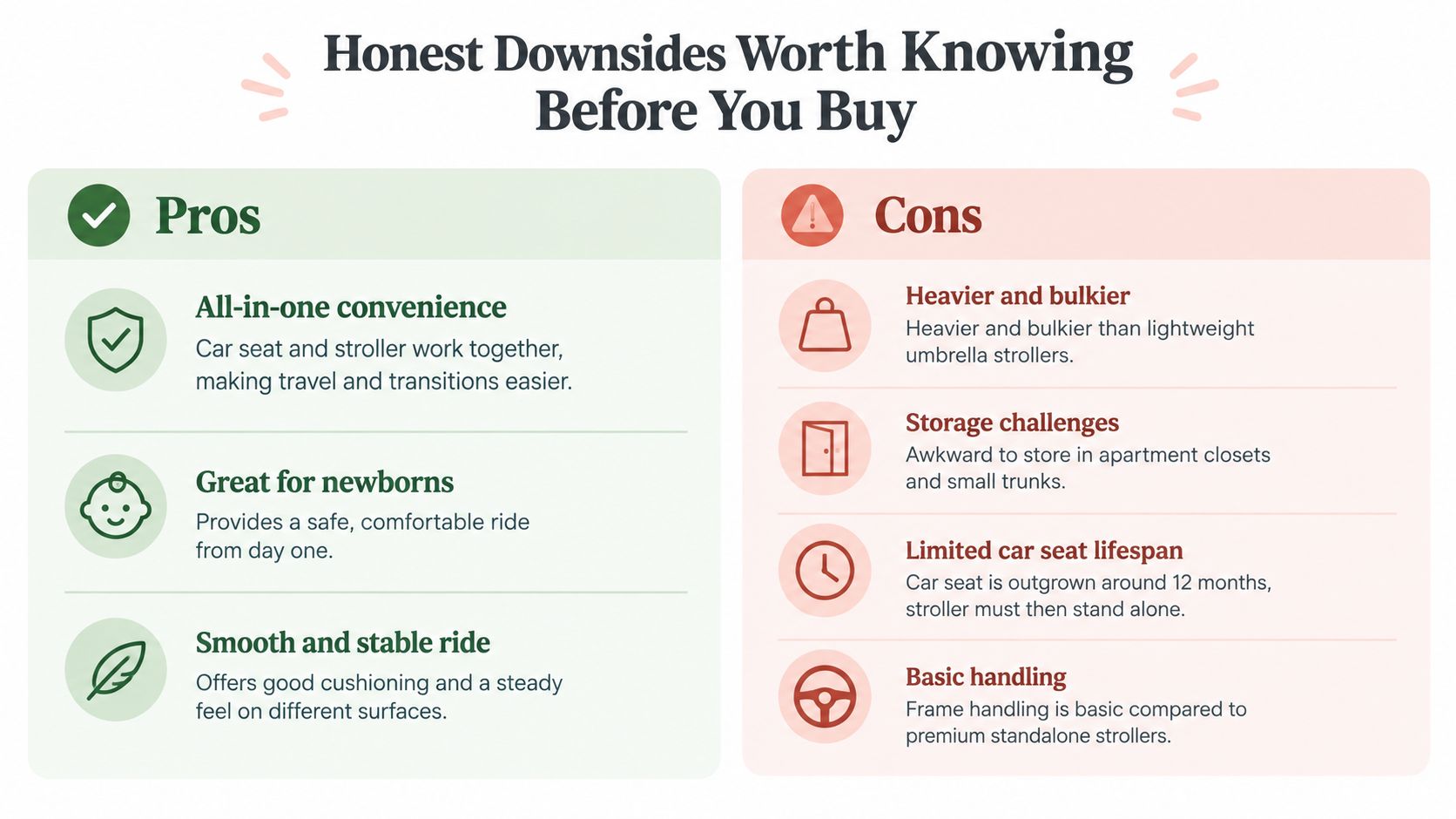
The biggest weakness is physical bulk. A travel system frame and attached infant car seat take up more space than a lightweight stroller, and the combined setup can be awkward in a narrow hallway, on apartment stairs, or beside a crowded café table. A large trunk may handle it comfortably. A small trunk may not.
Consumer Reports makes the same practical point in its travel-system discussion. The convenience of keeping a sleeping baby in the carrier comes with the effort of pushing both pieces together, and stairs quickly expose the extra weight and footprint.
The newborn phase doesn't last forever
The infant carrier is usually the part parents outgrow first. Chicco notes that many travel-system stroller seats have weight limits around 50 pounds, while the infant car seat is commonly outgrown much sooner, often around 10 to 14 months. See the manufacturer's travel-system guidance on stroller lifespan and seat limits.
That creates an important question: what happens next? If the stroller frame includes a proper toddler seat, the purchase can continue to make sense. If the frame is mainly a carrier dock and the toddler configuration is limited or uncomfortable, you may end up buying another stroller sooner than expected.
Where the bundle becomes inconvenient
Air travel is another weak spot. A full-size frame can be awkward to carry through an airport and inconvenient to gate-check, while a lighter stroller and separate infant carrier may be easier to manage. Families who fly often should check airline handling rules and think carefully about what they'll carry through terminals, rental-car lots, and hotel corridors.
The upfront price can also feel high because you're purchasing several coordinated components at once. Buying a stroller and a convertible car seat separately may spread purchases across different stages, although that route sacrifices the carrier-to-stroller transfer.
Practical rule: If you regularly climb stairs, use public transit, or fly, treat folded size and carrying weight as primary requirements. Don't let newborn click-in convenience hide a daily storage problem.
Travel System vs Modular and Separate Setups
There isn't one universally correct configuration. Each setup answers a different question: Do you want the fastest newborn transfer, the most flexibility as your family changes, or the lightest everyday stroller routine?
A travel system prioritizes simplicity. The infant seat and stroller are selected to work together, so the first-stage routine is clear. A modular frame prioritizes configuration. It may allow different seats, bassinets, or future additions, but you'll need to confirm that each component is compatible. A separate stroller and car seat prioritize independent performance, which can make the stroller lighter for everyday walks but requires more handling between the car and stroller.
| Factor | Travel System | Modular Frame | Separate Stroller + Car Seat |
|---|---|---|---|
| Newborn routine | Click the infant carrier onto the frame | Configure the compatible components | Transfer the baby between the car seat and stroller |
| Compatibility work | Usually established in the bundle | Check every added component | Check stroller, seat, and adapter pairing |
| Car-to-stroller speed | Fastest when the system is ready | Fast if the chosen setup docks directly | Slower if the baby must be moved |
| Weight per outing | Often more substantial | Depends on the selected frame and seat | Stroller can be lighter when used alone |
| Trunk footprint | Often one large combined setup | Changes with configuration | Pieces can be divided between spaces |
| Infant-to-toddler transition | Depends on the stroller seat | Usually designed for changes over time | You choose when and how to replace pieces |
| Future siblings | May require a new configuration | Often offers more planning flexibility | Separate purchases may be needed |
| Resale considerations | Coordinated bundle can be easier to explain | Individual parts may appeal to different buyers | Pieces can be sold or retained separately |
Market coverage reflects this shift toward flexibility. One report projects travel systems as the fastest-growing stroller product type, with a 6.32% CAGR through 2031. Review the travel-system market projection, but treat it as an industry forecast, not a reason to buy a bulkier setup than your home and car can handle.
Long-term value depends on use. A modular system may justify its complexity for a family expecting changing seating needs. A separate setup may suit frequent flyers who value a compact stroller. A travel system makes the most sense when the infant-carrier transition will happen repeatedly, not occasionally.
For a closer look at the car-seat decision behind these configurations, compare a convertible car seat with a travel system.
Which Setup Fits Your Family's Routine
The right choice becomes clearer when you follow a family through a normal day instead of comparing features in a showroom.
The apartment couple
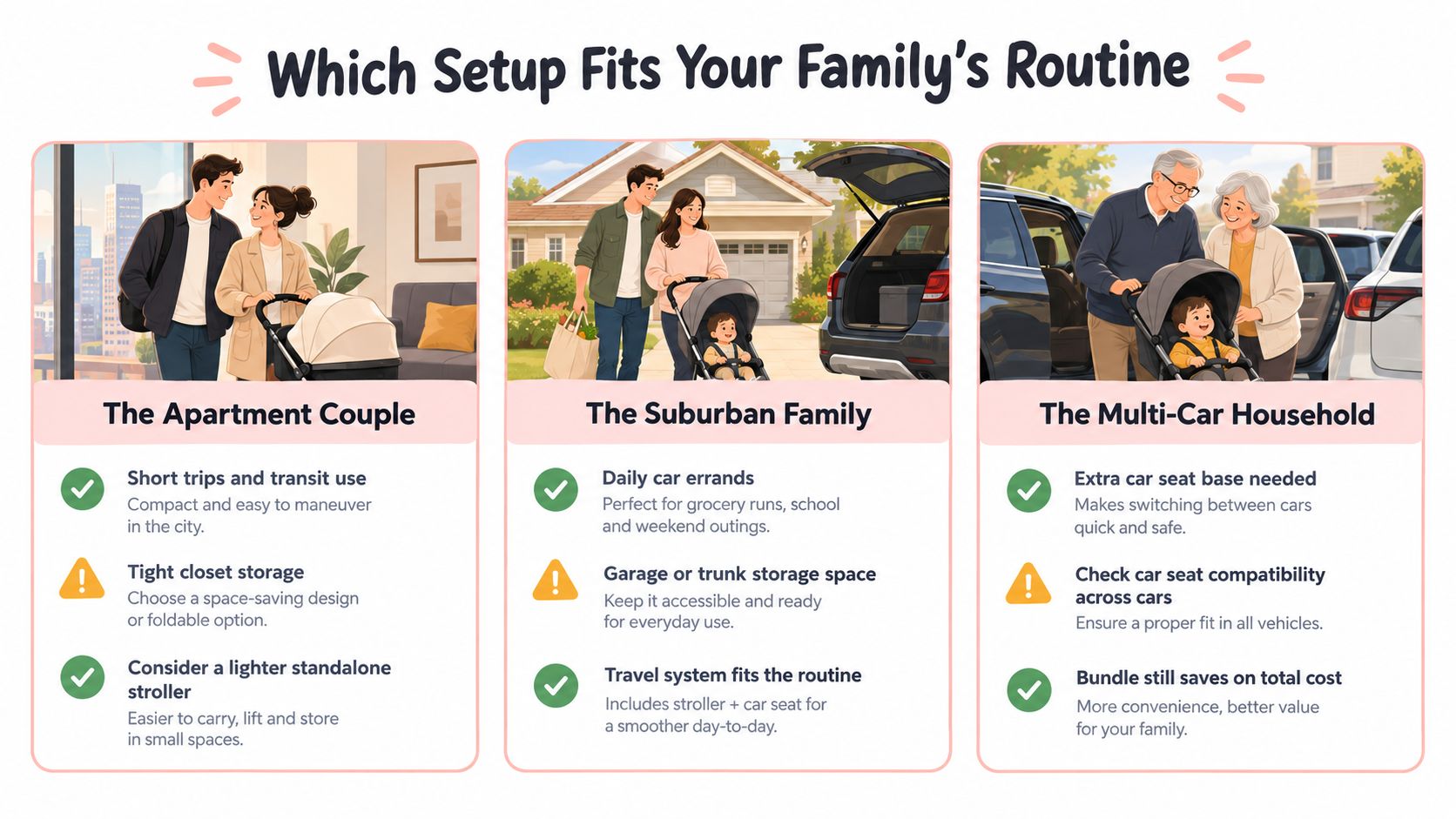
They live above street level, fold the stroller in a hallway closet, and use transit for short trips. Every outing includes carrying the stroller through a doorway, navigating a narrow sidewalk, and storing it again before dinner. For them, folded dimensions, lift weight, and wheel maneuverability matter more than a bundled attachment mechanism used only occasionally.
A travel system can still work if the stroller folds compactly and the infant carrier rarely leaves the building. But if the frame must be carried up stairs several times a day, the bulk becomes a recurring tax. A lighter standalone stroller paired with a car seat for driving days may be the calmer choice.
The frequent-flyer family
This household moves through airport gates, rental cars, hotels, and unfamiliar sidewalks. They need gear that can be lifted, folded, and stored without turning every connection into a physical project. A compact stroller and portable infant carrier may suit them better than a full travel system, especially when the stroller will spend more time in terminals than in a trunk.
Check the stroller's folded dimensions, carrying method, and travel handling instructions before purchase. “Travel system” doesn't automatically mean “easy to travel with.” Bundled convenience applies most directly to car-to-stroller transitions, not every form of transportation.
The one-car suburban family
Travel systems often shine here. The stroller lives in the trunk, the family drives to daycare, grocery stores, medical appointments, and parks, and the infant carrier moves between the car and frame several times a day. The bundle keeps the routine consistent for parents, grandparents, and other caregivers.
One industry review evaluated 18 travel systems in 2026 for ease of use, safety, maneuverability, crash protection, and vehicle fit. See the review's stated evaluation scope, but still test the specific model with your own vehicle. A system that works beautifully in a large trunk may be frustrating in a compact hatchback.
Hybrid families often change setups across stages. They may begin with a travel system for newborn errands, keep the stroller frame for toddler walks, and add a compact stroller for flights. That's a sensible plan when the first purchase solves the immediate routine without pretending one product must handle every future situation.
Safety, Compatibility, and What to Verify First
Treat safety and fit as separate checks. A travel system combines an infant restraint with a stroller, and each component has its own requirements. In the United States, relevant standards include FMVSS 213 for child restraints, ASTM F833-19 for strollers, and ASTM F2050-19 for hand-held infant carriers. Review the listed U.S. product standards.
The label is only the starting point. Read the current instructions for the exact infant seat, base, and stroller frame. Confirm that the infant seat is approved for the stroller, that any adapter is the specified model, and that the connection locks without looseness, unexpected movement, or an incomplete indicator.
Compatibility checks before checkout
Only an infant car seat is designed for travel-system docking. Convertible, forward-facing, rotating, and booster seats don't attach to strollers in the same way. A compatibility list matters more than a product photograph, because an infant seat that fits one stroller may need a particular adapter, or may not be approved for another frame at all. Use this compatibility guide to check an infant seat and stroller pairing.
Run this checklist before you buy:
- Confirm the exact model: Match the full infant-seat name and stroller model, not just the brand family.
- Check the base: Verify whether the base is included and whether another vehicle requires an additional approved base.
- Inspect the harness: Look for an adjustable five-point harness and confirm that you understand its fit instructions.
- Test the brake: Engage the brake and make sure the stroller stays in place.
- Check the release: Learn how the car seat releases from both the vehicle base and stroller frame.
- Ask about returns: Confirm whether an opened or test-fitted car seat can be returned.
- Register the seat: Complete the manufacturer registration process so safety notices can reach you.
Stroller-related injuries remain a meaningful concern. A Nationwide Children's Hospital summary of research linked through NCBI reports that, over the 21 years ending in 2010, about 360,937 children under age five were treated in U.S. emergency departments for stroller and infant-carrier injuries. The same summary reports that an average of one child age five and under is treated every 45 minutes, and that traumatic brain injuries and concussions account for 25% of stroller-related injuries. Use the harness, engage the brake, keep the frame stable, and follow the instructions every time.
For adapter questions, review this car-seat adapter guide before placing an order.
Choosing the Right Travel System With Confidence
Make the decision with three honest answers:
- Where will the stroller live when you aren't using it? Measure the closet, hallway, garage, and trunk.
- How often will it leave the car? Frequent car-to-stroller transitions favor a travel system.
- Does your family already need a specific car seat? A required seat can narrow compatibility or make a bundle redundant.
Your answers point toward a practical configuration.
Choose a bundled travel system when
You drive for most errands, expect repeated newborn transfers, and have enough storage for a substantial frame. This is the strongest fit for a one-car household that visits daycare, shops by car, and wants caregivers to follow one straightforward routine.
Look beyond the infant stage. A market report notes that premium systems dominate revenue, while convertible systems supporting infant-seat and toddler-seat use grew 22% year over year, and traditional all-in-one bundles declined 6.8% in units sold. Read the market analysis behind these configuration trends. The useful lesson isn't to chase a trend. It's to check whether the stroller remains valuable after the carrier is gone.
Choose modular flexibility when
You expect your family's seating needs to change, want to add components later, or prefer configuring the stroller around more than one stage. Modular designs demand more compatibility research, but they can reduce the chance that the entire setup feels obsolete after the newborn period.
Choose separate pieces when
You fly often, live in a small space, or want a lighter stroller for daily walking. You'll give up the carrier transfer, but you may gain a more manageable stroller for transit, stairs, and travel.
Before buying, check:
- Folded weight and dimensions: Lift the folded stroller and measure the actual storage space.
- Trunk fit: Test the stroller with the infant carrier and other essentials you routinely carry.
- Toddler configuration: Confirm how the stroller works after the infant seat is outgrown.
- Harness adjustment: Make sure the straps are easy for caregivers to tighten correctly.
- Warranty terms: Read what the warranty covers and how long it lasts.
- Return policy: Check the conditions before opening or installing the car seat.
- Compatibility list: Save the exact approved pairing for future reference.
For a focused shortlist, browse this guide to baby travel systems. Then choose the setup that fits your actual week, not the imaginary week where every outing happens on a smooth sidewalk with an empty trunk.
If you drive often and want newborn convenience, buy the travel system. If you carry gear up stairs or fly regularly, prioritize portability. If you're still unsure, measure your storage space first, then choose the lightest configuration that solves your most common trip.
NINI and LOLI offers travel systems, infant car seats, strollers, and related baby gear to help families build a coordinated setup around their real routines. Visit NINI and LOLI to compare compatible options, review practical buying guides, and choose the pieces that will keep working as your baby grows.