


Choosing your baby's first car seat is a major milestone. As a parent, you want nothing but the safest ride for your little one, but with regulations shifting and new 2026 standards coming into effect, navigating the market can feel like a full-time job.
The top infant car seat brands earn their reputation by delivering on what matters most: unmatched safety, parent-friendly design, and real-world reliability. But in 2026, "reliability" also means adapting to tighter side-impact rules and updated federal testing protocols.
To cut through the marketing noise, consider how the 2026 regulatory environment changes what you should buy, compare the actual safety mechanics that protect a newborn, and apply a clear decision framework based on your lifestyle, whether you prioritize the easiest installation, an integrated travel system, or long-term value.
Ready to find the perfect fit? Browse our curated collection of top-tier car seats at NINI and LOLI.
Finding Your Perfect Infant Car Seat for 2026

The first drive home with your newborn is a moment you'll cherish forever. Ensuring they are as safe as possible is every parent's top priority. But with the market evolving, the choices can feel overwhelming.
What Changed for 2026 Shoppers?
The most significant update for 2026 is the enforcement of stricter federal safety standards in the United States. The compliance deadline for enhanced side-impact protection has been extended to December 5, 2026, meaning all car seats sold in the U.S. from that date onward must meet updated federal requirements aimed at improving side-impact protection Reference URL: https://www.trafficsafetymarketing.gov/safety-topics/child-safety/car-seats-boosters-seat-belts.
Additionally, the global child safety seat market is projected to reach USD 5.03 billion this year, driven by both steady demand and these tighter safety rules Reference URL: https://www.gminsights.com/industry-analysis/child-safety-seat-market. For parents, this means prioritizing seats that already exceed current federal tests, particularly those equipped with robust side-impact protection, rather than waiting for model years that may be scarce or marked up. Either way, the baseline for safety has moved up.
How to Narrow Your Choices
Rather than buying based on aesthetics alone, I recommend narrowing your search by three practical criteria:
- Newborn Fit: Can the seat accommodate a premature or low-birth-weight baby securely? Look for adjustable recline angles and specific crotch pad positions.
- Installation Confidence: Will you install it correctly every time? Features like built-in lock-offs, bubble levels, and color-coded LATCH paths reduce human error.
- Travel System Compatibility: Does it click into the stroller you already own or plan to buy? Universal adapters exist, but brand-specific clicks are generally more secure and easier to use.
Quick Decision Snapshot
- Best for Smallest Newborns: Infant seats with deep, adjustable recline and slim profiles.
- Best for Easiest Installation: Seats with rigid LATCH connectors and clear visual feedback (levels/indicators).
- Best for Travel Systems: Brand-matched infant carriers (e.g., Nuna, UPPAbaby).
- Best for Long-Term Value: High-weight-limit infant seats or starting with a convertible if portability isn't critical.
Why Brand Matters
Choosing a reputable brand often means better customer support, clearer instructions, and more frequent safety updates. For a deeper dive into the factors that matter most when selecting a carrier, check out our guide on how to choose a car seat.
How We Evaluated the Top Infant Car Seat Brands for 2026
To ensure this guide remains useful and evidence-based, we evaluated brands using a multi-layered framework rather than relying solely on manufacturer claims. Here is the methodology we applied to identify the top infant car seats for 2026:
1. Safety Compliance and Testing Rigor
We prioritized seats that not only meet but exceed FMVSS 213. We looked for brands that invest in independent third-party testing, particularly for side-impact protection. While federal tests cover frontal crashes, the new 2026 side-impact sled tests are critical. We cross-referenced these with data from organizations like the NHTSA and independent consumer advocacy groups.
2. Ease of Use and Installation Error Reduction
A safe seat installed incorrectly is dangerous. Therefore, we heavily weighted features that reduce installation complexity, such as load legs, anti-rebound bars, and intuitive LATCH systems.
3. Newborn Ergonomics
For infants, fit is safety. We evaluated how well each seat cradles a small newborn, focusing on harness adjustability, head support, and the ability to maintain a semi-reclined position that keeps an infant's airway open.
4. Real-World Parent Feedback
We aggregated feedback from verified purchasers and parenting communities to identify common pain points—such as heavy carrier weight, difficult fabric cleaning, or confusing base mechanisms—that might not show up in technical specs.
This methodology ensures that our recommendations are grounded in safety data and practical daily use, not just brand prestige.
Understanding Core Car Seat Safety Features
When you look at a row of infant car seats, you're seeing more than just fabric and plastic. You're looking at advanced safety engineering. However, understanding what these features do, and what they don't do, is key to making an informed choice.
The Reality of Federal Compliance
Every car seat sold in the U.S. must pass Federal Motor Vehicle Safety Standard 213 (FMVSS 213), which simulates a 30-mph frontal crash. Meeting this standard is the minimum, not the goal.
NHTSA data states that car seats reduce the risk of fatal injury by 71% for infants and 54% for toddlers ages 1 to 4 in passenger cars. The same source says child restraints have saved the lives of 11,606 children under age 5 since 1975, a long-term reminder that correct restraint use has had a measurable public-health impact over nearly five decades Reference URL: https://www.fromtheroad.ford.com/us/en/articles/2026/child-passenger-safety-week-car-seat-check. These figures underscore one critical point: the seat must be used correctly. The same data notes that recent inspection data show that 67.1% of all car seats checked in 2024 were incorrectly installed Reference URL: https://www.fromtheroad.ford.com/us/en/articles/2026/child-passenger-safety-week-car-seat-check.
Interpreting Manufacturer Claims vs. Independent Testing
Manufacturers often use terms like "extra-safe" or "premium protection." To verify these claims, look for:
- Side-Impact Certification: Is the seat certified by organizations beyond the government?
- Crash Test Videos: Reputable brands often publish their own high-speed crash test footage.
- Recall History: Check the NHTSA website for any past recalls related to structural integrity or harness mechanisms.
Side-Impact Protection (SIP)
Real-world accidents aren't always head-on. Side-impact collisions pose a significant danger. This is why the upcoming 2026 side-impact requirements are such a big deal for safety. SIP is designed to shield your baby’s most vulnerable areas: their head, neck, and torso.
Brands implement SIP in various ways:
- Integrated Wings: Deep side walls are built directly into the car seat's shell.
- External Pods: Attachments on the side of the seat act as the first point of contact.
- Layered Foam: Multiple layers of energy-absorbing foam compress to slow down impact forces.
Think of SIP as a protective cocoon. It’s engineered to absorb and redirect the powerful forces from a side crash, shielding your little one from harm.
Key Safety Features in Top Infant Car Seats
| Safety Feature | What It Does | Why It Matters for Your Baby |
|---|---|---|
| Side-Impact Protection (SIP) | Uses deep side walls, foam, and/or external pods to absorb crash forces. | Protects the head, neck, and spine—the most vulnerable areas—in a side collision. |
| Energy-Absorbing Foam (EPP/EPS) | Lines the car seat shell to cushion your baby and absorb impact energy. | Acts as a crucial buffer, reducing the G-forces that reach your child during a crash. |
| Anti-Rebound Bar (ARB) | A steel bar on the base that presses against the vehicle seat back. | Prevents the car seat from violently bouncing back ("rebounding") after a frontal impact. |
| Load Leg (Stability Leg) | A support that extends from the base to the vehicle floor. | Drastically reduces forward rotation in a crash, absorbing energy and minimizing stress on the baby's neck. |
| Steel-Reinforced Frame | Incorporates a steel frame into the seat’s plastic shell. | Adds strength and durability, preventing the seat from flexing or breaking under extreme crash forces. |
Red Flags to Avoid
Even if a seat markets premium safety features, watch out for these red flags:
- No Load Leg or ARB: For infant seats, these are critical for stability. Their absence may indicate an older or less robust design.
- Vague "Side-Impact" Claims: If a brand doesn't specify how it protects against side impacts (e.g., mentioning specific foam types or wing structures), be skeptical.
- Hard-to-Clean Fabrics: While not a safety feature per se, difficult-to-clean fabrics can lead to hygiene issues or discourage proper installation checks.
Learn more about what makes a car seat safe at how to choose the safest car seat for your baby.
Infant Car Seat vs. Convertible Car Seat
One of the first decisions new parents face is whether to choose an infant car seat or a convertible car seat. There's no single "right" answer—the best choice depends on your lifestyle and priorities.
Newborn-Specific Considerations
For parents of newborns, especially premature or small babies, the infant car seat often provides a superior fit. These seats are designed to cradle a tiny body in a semi-reclined position, which is crucial for maintaining an open airway. Convertible seats, while capable of rear-facing use, can sometimes be bulkier and harder to angle correctly for a very small infant.
However, convertibles are advancing. Some high-end convertibles now offer excellent newborn inserts and recline options. If you plan to use the seat exclusively in the car and rarely move it, a convertible can be a smart long-term investment.
Infant Seats: The Convenience Winner
Infant car seats are specifically designed for newborns and small babies, typically from 4 to 35 pounds. Their design focuses on making life with a newborn easier and safer.
These lightweight, portable seats feature a carrying handle, which allows you to move your baby from the car to the stroller to home without unbuckling them. Anyone who has tried to move a sleeping baby knows this is invaluable.
Here’s what makes them so popular:
- Portability: The carrier is designed to be removed from the car, perfect for errands.
- Travel System Ready: Most infant seats from top infant car seat brands click into a matching stroller.
- A Perfect Fit for Newborns: They provide a snug, secure fit for the smallest babies, often with special support inserts.
- Click-and-Go Convenience: The base stays installed in your car, and the carrier clicks in and out.
Convertible Seats: The Value Winner
A convertible car seat is a long-term solution. It "converts" from a rear-facing seat for babies to a forward-facing one for toddlers. For many, it's a one-and-done purchase.
Unlike an infant carrier, a convertible seat is large, heavy, and stays installed in your car. It is not designed to be portable.
A convertible car seat offers incredible long-term value, adapting as your child grows. It saves you from needing to buy a new seat after the first year, making it a budget-friendly choice over time.
However, consider the trade-offs:
- No Portability: You cannot carry your baby in the seat, meaning you must unbuckle them every time you leave the car.
- Newborn Fit: While rated for newborns, some models can be bulky and may not offer the same snug fit as an infant-specific seat.
- No Stroller Clicks: These seats do not connect to a stroller to form a travel system.
Quick Comparison for Newborn Families
| Feature | Infant Car Seat | Convertible Car Seat |
|---|---|---|
| Fit for Tiny Babies | Excellent (deep recline, slim profile) | Good to Variable (check newborn insert) |
| Portability | High (carry handle, lightweight) | Low (heavy, stays in car) |
| Stroller Use | Yes (travel systems) | No (requires adapter or separate stroller) |
| Duration of Use | ~0–12 months | ~0–4+ years |
| Best For | Active parents, travel systems | Budget-conscious, car-only use |
For more on travel accessories, you might also find The Essential Guide to Your Car Seat Canopy Cover from Lounge Wagon helpful for keeping your newborn shaded and comfortable on the go.
When you're ready for the next stage, learn more in our guide to the best convertible car seats.
How to Install Your Infant Car Seat Correctly
You can buy the most advanced car seat, but its safety features are only effective if installed correctly. A loose car seat is a dangerous one. Fortunately, the top infant car seat brands have designed their products to make installation more intuitive than ever.
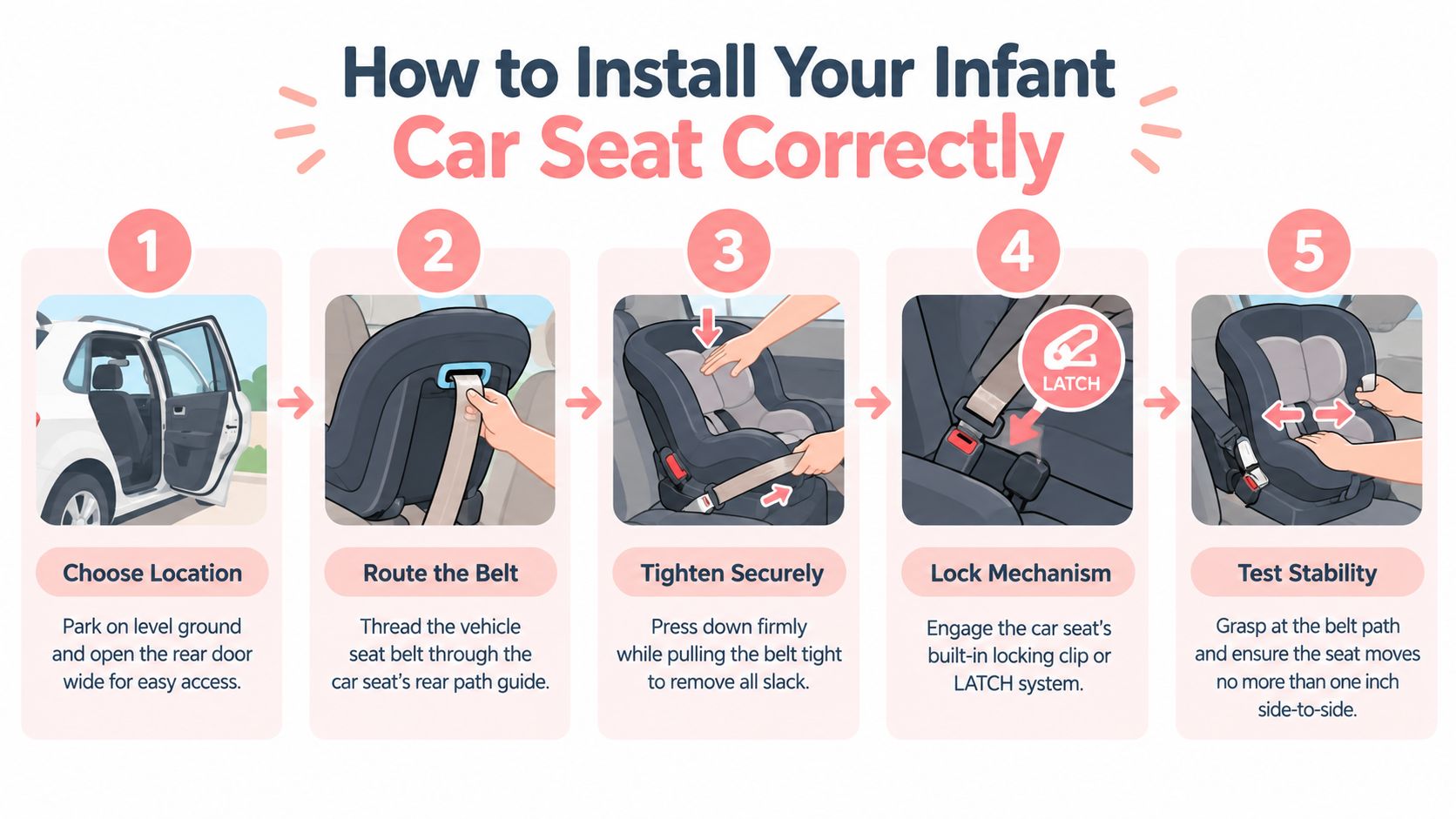
A seat's built-in protection is only effective when it's completely stable. It all starts with a rock-solid installation in your car.
You have two methods for installing the base: your vehicle's LATCH system or the seat belt. Neither is safer; the safest method is the one that gives you a tight, secure fit in your vehicle.
LATCH System Installation
LATCH (Lower Anchors and Tethers for Children) was designed to simplify installation. Your vehicle has small metal loops called lower anchors located where the seat cushions meet.
Installation with LATCH is typically a three-step process:
- Locate the lower anchors in your back seat, often marked with a symbol.
- Push the connectors from the car seat base onto the anchors until you hear a solid "click".
- Pull the LATCH strap to tighten the base firmly against the vehicle seat.
Some premium bases feature rigid LATCH connectors that click into place, making installation even easier.
Seat Belt Installation
If your car lacks LATCH anchors in your desired position (like the middle seat) or if the seat belt provides a better fit, this method is equally safe when done correctly.
Many of the best seats have a game-changing feature: a built-in lock-off device. It’s a clamp on the base that secures the seat belt, preventing it from loosening over time—a common installation mistake.
Here’s how to install the base with a seat belt:
- Route the seat belt through the indicated belt path on the base.
- Buckle the seat belt.
- Apply your weight to the base while pulling the shoulder belt to remove all slack.
- Engage the seat’s lock-off to hold it securely in place.
Confirming a Secure Fit
Regardless of the method used, perform the "one-inch test."
Grab the base near the belt path and pull it side-to-side and front-to-back. The base should not move more than one inch in any direction. If it does, uninstall and repeat the process for a tighter fit. A secure base is essential for your baby's safety.
For a closer look at a popular brand's features, explore our guide on Nuna infant car seat compatibility and base options.
Building Your Perfect Travel System

One of the best features of an infant car seat is its ability to create a travel system. This is when your car seat clicks directly onto your stroller, allowing you to move a sleeping baby from the car to the sidewalk seamlessly.
The top infant car seat brands offer the flexibility to mix and match, so you can choose the car seat you love and pair it with the stroller that best fits your lifestyle.
Understanding Car Seat and Stroller Compatibility
The simplest approach is to stick with the same brand. For example, a Nuna car seat is designed to click onto a Nuna stroller without any extra parts. The same applies to UPPAbaby and other leading brands.
But what if you love a car seat from one brand and a stroller from another? Adapters make them compatible.
An adapter is a small piece of hardware that bridges the gap between different brands. It clicks onto your stroller and creates the correct connection point for your car seat to snap into securely.
Think of it like a universal key that makes two different products work together perfectly.
Finding the Right Adapters
Using adapters is simple, but you must get the right ones for a safe and secure connection.
Here’s what to check for:
- Car Seat Brand Specific: Adapters are designed for specific car seat connectors. You'll often see adapters for "Maxi-Cosi style" car seats, a common design used by Nuna, Cybex, and Maxi-Cosi.
- Stroller Model Specific: The adapter must also be made for your exact stroller model. An adapter for an UPPAbaby Vista won't work on an UPPAbaby Minu.
Always double-check product descriptions for both the stroller and the adapter to confirm compatibility. This will save you time and frustration. For a real-world example, see our guide on effortless integration with the Nuna stroller and car seat combo.
Ready to create your perfect travel system? The team at NINI and LOLI is here to help. Explore our collection of strollers and accessories and get started today.
Comfort and Convenience Features
While safety is always the top priority, the comfort and convenience features are what you'll appreciate in your daily life. The top infant car seat brands focus on details that make parenting easier.
A car seat is only great if your baby is happy in it and it's easy for you to use. The best seats are designed with a deep understanding of the challenges of new parenthood.
Why Fabric Matters
Your baby’s skin is delicate, so the materials they are surrounded by are important. The best car seats use fabrics that are soft, breathable, and gentle.
Here’s what to look for:
- Breathable Fabrics: These promote airflow, helping to prevent your baby from overheating during car rides.
- Merino Wool Blends: High-end brands like Nuna often use merino wool. It's naturally flame-retardant, soft, and helps regulate temperature.
- Chemical-Free Options: Brands like UPPAbaby and Nuna offer "FR-free" options that meet all federal safety standards without using added chemical flame retardants.
Little Features That Make a Big Difference
When you're juggling a baby and a diaper bag, every helpful detail counts.
A no-rethread harness is a feature you'll love. Instead of re-routing straps through small slots as your baby grows, you lift the headrest, and the harness adjusts with it. It’s a one-handed adjustment that ensures a perfect fit every time.
A lightweight carrier can make a huge difference in your day-to-day life. Shaving off even a pound or two makes carrying your baby from the car to the store much easier on your back.
Life with a baby is messy. That's why machine-washable fabrics are a must-have for most parents. The ability to remove the cover and toss it in the wash makes cleanup much easier.
Finally, a large, extendable canopy with a high UPF rating protects your baby's skin and creates a cozy space for naps. These thoughtful details add up to a better experience for both you and your baby.
FAQ: Your Infant Car Seat Questions Answered
Choosing from the top infant car seat brands is a big decision, and it's normal to have questions. Here are answers to some of the most common ones we hear from parents, including specific queries about 2026 safety standards.
What is the safest car seat in 2026?
There is no single "safest" car seat, as safety depends on correct installation and fit for your specific child and vehicle. However, the safest seats in 2026 will be those that comply with the updated federal side-impact standards taking effect in December. When evaluating safety, look for seats with load legs, anti-rebound bars, and high-quality side-impact foam. Always check NHTSA recall databases and independent test results before purchasing.
What is the best infant car seat in 2026 for newborns?
The "best" infant car seat for a newborn is one that provides a snug, secure fit with adequate recline to keep the baby's airway open. Look for seats with adjustable harness heights, removable newborn inserts, and a compact design for smaller babies. Brands like Nuna and UPPAbaby are often praised for their thoughtful ergonomics for tiny infants. Ultimately, the best seat is the one that installs correctly in your car and fits your baby properly.
How should parents compare infant car seat safety ratings?
Parents should look beyond manufacturer claims. Start with NHTSA data and recall histories. Then, consult independent testing organizations and consumer reviews that focus on real-world installation ease and crash protection features. Pay attention to whether the seat includes a load leg or anti-rebound bar, as these features significantly reduce movement during a crash. Also, verify that the seat meets the latest 2026 side-impact guidelines if you are buying new.
When does my baby outgrow their infant car seat?
Your baby has outgrown their infant seat when they reach either the maximum height or weight limit—whichever comes first. This is not based on age. A simple way to check is the "one-inch rule": if the top of your baby's head is less than one inch from the top of the car seat shell, it's time to upgrade to a rear-facing convertible car seat.
Is it safe to use a second-hand car seat?
We strongly advise against using a second-hand car seat unless it comes from a trusted source who can guarantee its history. Used car seats carry invisible risks. They have expiration dates (usually 6–10 years from manufacture) because the plastic can become brittle. You can't know if a seat has been in an accident, which could compromise its structural integrity.
Buying a new car seat is the only way to be absolutely sure it meets all current safety standards, has every original part, and hasn't been weakened by damage you can't see.
Why should I register my new car seat?
When you unbox your car seat, you’ll find a registration card. Filling this out immediately is an important safety step. Registering your seat allows the manufacturer to contact you directly in the event of a safety recall. It’s free, takes only a minute, and provides invaluable peace of mind.
What are flame retardant-free car seats?
Federal regulations require car seat materials to be fire-resistant. In the past, this was achieved with chemical flame retardants. Today, many parents prefer to minimize their baby's chemical exposure.
In response, top infant car seat brands have developed "FR-free" seats. These models use naturally flame-resistant fabrics, like merino wool blends, to meet safety standards without added chemicals.
Brands like Nuna and UPPAbaby are leaders in offering FR-free options.
At NINI and LOLI, we understand how important these decisions are. Our team is here to answer any other questions and help you find the safest, most suitable car seat for your family. Explore our full collection today and drive with confidence.