


Banana is smeared across the tray, one hand is reaching for the spoon, the other is trying to keep a phone from sliding off the table, and one thought keeps nagging at you: is this high chair safe? You want a seat that keeps your baby secure, wipes clean without a fight, and doesn't take over the kitchen.
A high chair becomes part of daily family life quickly. It may be used for breakfast, lunch, dinner, snacks, and messy self-feeding for years, so the right choice should reduce friction rather than add to it. Before you buy, measure your dining space, inspect the chair's structure, and prioritize a secure harness and supported sitting position. Then shop with your actual routine in mind, not just the chair's appearance.
Why Choosing the Right High Chair Matters
The wrong high chair usually reveals itself during an ordinary meal. The tray sits too far from your baby, the footrest is decorative rather than useful, the buckle takes two adults to operate, and food disappears into seams you can't reach. By the time you finish wiping the table, the chair, the floor, and the baby, you're already dreading the next meal.
The right chair feels less noticeable. Your child sits upright and comfortably contained, the tray stays within easy reach, and cleanup follows a predictable routine. That matters because a high chair isn't occasional equipment. It becomes the place where your baby explores purées, grasps finger foods, joins family meals, and learns the rhythm of eating.
Put safety before style
A beautiful finish can't compensate for a narrow or wobbly base. Stability, restraint geometry, strong connections, and a practical cleaning design deserve attention before color or décor. Safety data makes that priority clear. A classic U.S. emergency-department study estimated 40,650 high-chair-related injuries over five years among children age three and under, with 94% caused by falls. The same data recorded 44% involving the head and 39% involving the face, while the mean child age was 10 months. These figures appear in the CPSC nursery products annual report.
That doesn't mean every meal should feel frightening. It means infant-stage restraint and chair stability aren't optional features to trade away for a smaller footprint or prettier frame.
Think about your real routine
A parent who feeds at the dining table needs different conveniences from a parent who moves the chair between a kitchen island and a small apartment living room. Ask yourself:
- Where will it live? Measure the chair's full footprint, not only its folded size.
- How messy are your meals? If self-feeding is part of your plan, prioritize smooth surfaces and a removable tray.
- Who will use it? A chair that converts for a growing child may suit siblings or grandparents.
- What will frustrate you daily? Difficult straps, deep crevices, and poor wheels become more important than decorative details.
If you're building a broader registry, use this baby registry checklist to place the high chair alongside the feeding and care items you'll use.
My strongest buying advice is simple: choose the safest stable chair that fits your home and your cleanup tolerance. Everything else, including finish, accessories, and extra modes, comes after that.
Safety Standards and Stability Essentials
Before buying or accepting a high chair, put it on the floor where your child will use it. Check the compliance information, then test the frame, locks, and contact points yourself. In the United States, the federal high-chair rule incorporates ASTM F404-21 through 16 CFR part 1231. The CPSC high-chair business guidance identifies this mandatory standard as the safety checkpoint for current products.
A newer chair still needs a physical inspection. For a secondhand chair, check its manufacture or import date before considering it. The federal standard applies to high chairs manufactured or imported on or after June 19, 2019, according to the CPSC effective-date notice. If the date, model information, or instructions are missing, choose another chair.

Feel for a stable base
A chair can look sturdy and still shift when a child pushes against the tray or nearby furniture. Choose a broad, balanced base with feet that remain planted. If it has wheels, engage every brake and try to move the frame. A lock that releases under light pressure is a deal-breaker.
Practical testing checks include a wide base, resistance to tip-over on flat surfaces, and the ability to handle static loading without sagging, deforming, or collapsing. The high-chair buying guide explains these testing principles. You can also compare current options in our guide to top-rated high chairs, then apply the same hands-on checks before buying.
Use this inspection sequence in a store or at home:
- Place the chair on a flat surface and engage every lock.
- Push the seat gently from the front, back, and both sides.
- Apply steady downward pressure to the seat and backrest.
- Listen for creaks and watch for shifting legs, loose joints, or frame flex.
- Repeat with a small, evenly distributed weight in the seat, never with a child inside.
Apartment living makes the surrounding space part of the stability check. Keep the chair away from counters, walls, tables, and other surfaces a child could push against. Measure the open footprint around the chair, not only its folded size, so the feeding position does not block a walkway or sit against a sharp corner.
Inspect the restraint area
The CPSC states that the mandatory standard requires at least a three-point restraint system and a passive crotch restraint. Its federal safety-standard announcement notes that many experts consider a five-point harness safer because it helps limit leaning, standing, and sliding out.
Check the buckle, strap stitching, adjustment points, and crotch restraint before purchase. Straps should lie flat, adjust smoothly, and remain attached without twisting. A buckle should release deliberately for an adult but resist easy operation by a child.
Safety is the baseline, not an upgrade. Reject any chair that wobbles, has incomplete restraints, damaged locking parts, cracked plastic, or missing hardware, regardless of its appearance or compact footprint.
Harness, Tray, and Adjustability Features
A harness should match your child's movement, not just the label on the box. For a younger baby who is learning to sit and beginning solids, I favor a five-point harness with shoulder straps, waist straps, and a crotch strap. The shoulder straps help limit forward leaning and climbing, while the crotch strap blocks downward sliding.
A three-point harness can suit a more confident sitter or an older toddler when the design and manufacturer's instructions allow it. Don't remove shoulder straps or change the configuration casually. If you want flexibility, choose a chair specifically designed to convert between restraint modes and keep every original component.
Match the chair to the feeding stage
A six-month-old starting purées usually needs closer body support, a well-positioned tray, and a footrest that prevents dangling legs. An older self-feeding toddler needs space for hand movement, a tray that can handle a plate or food directly, and adjustments that keep the child near the table.
| Age & Stage | Harness Type | Tray Style | Adjustability |
|---|---|---|---|
| Early solids and supported sitting | Five-point harness with a close crotch restraint | Tray that moves close to the body and removes for cleaning | Upright seat, supportive footrest, and adjustable seat depth |
| Developing self-feeding | Five-point harness, adjusted snugly as the child grows | Removable tray with room for food and hands | Several footrest and tray positions |
| Confident toddler at family meals | Three-point or five-point configuration only where the design permits | Tray removed or shifted to table use | Seat and footrest aligned with the dining table |
| Older toddler using a converted seat | Manufacturer-approved restraint for that mode | Crotch bar or table-facing configuration as designed | Stable foot support and a comfortable seat height |
Choose tray convenience deliberately
A removable, dishwasher-safe tray is my first choice for everyday feeding. A one-hand release helps when you're holding a baby, and a double tray can separate a food surface from a cleaner base. A fixed tray may feel sturdy, but it can make table participation and deep cleaning harder.
Crotch-bar-only designs can work for older toddlers who are ready for that configuration, but they aren't a substitute for a complete restraint system during the earlier feeding stage. Also check whether the tray is large enough for your routine. A plate, cup, spoon, and a few pieces of food need usable space without pushing your child too far away.
Adjust the fit, not just the height
Seat height matters when the chair needs to pull up to your table. Footrest height matters even more for comfort and stability. Look for a setup that lets your child sit upright with supported thighs and feet, rather than dangling legs and a body that slides forward.
For a deeper look at adjustable seating and a chair designed to grow with a child, read this high-chair growth guide. The practical takeaway is broader than any one design: adjustability only counts when you can fine-tune the seat, tray, and footrest to your child today.
Materials, Cleaning, and Feeding Comfort
A high chair's material determines what happens after the banana, oatmeal, and yogurt hit the seat. Smooth plastic usually wipes quickly and may pair with a dishwasher-safe tray. Sealed wood can feel solid and furniture-like, but joints, grain, and leg grooves need closer attention. Padded foam adds softness, while fabric covers may demand machine washing and drying time.
I'd choose fewer seams over extra cushioning for a chair used several times a day. Comfort still matters, but a cushion that traps food around the edges can turn every meal into a small maintenance project.
Support the sitting position
Look for an upright seat with a supportive back, a sensible seat depth, and a footrest that your child can reach. The frequently used 90/90/90 position means the hips, knees, and ankles are each supported at roughly right angles. It gives your child a more grounded setup for reaching food and staying centered.
Avoid a broad, deep seat that leaves a small baby slumped or shifting from side to side. A tray shouldn't sit so far away that your child has to lean forward to reach food. As your child grows, adjust the seat and footrest rather than accepting a poor fit because the chair technically remains within its stated age range.
Practical rule: If you can't wipe the seat, inspect the harness, and reach the tray connection without moving three separate cushions, the design will probably test your patience.
Compare the cleaning tradeoffs
| Material | Comfort | Cleaning Ease | Durability |
|---|---|---|---|
| Smooth plastic | Firm, with comfort determined by the seat shape | Fastest to wipe when the surface has few crevices | Depends on frame quality and protection from cracks |
| Sealed wood | Firm and supportive, often with optional padding | Wipes well on sealed surfaces, but joints and grooves need attention | Can serve for extended use when maintained properly |
| Padded foam | Soft and forgiving for longer meals | Wipeable covers are convenient; fabric inserts require washing | Cover and seams may show wear sooner than the frame |
| Removable fabric insert | Adds softness and can improve fit | Requires regular machine washing and complete drying | Lasts according to fabric, stitching, and wash care |
The single biggest time-saver is a tray you can remove and place in the dishwasher. Check the tray's size before buying, because a tray described as removable isn't automatically convenient if it requires hand scrubbing every time.
For practical cleaning ideas that extend beyond feeding gear, this resource on baby changing tables for restrooms offers useful context on wipe access, surface maintenance, and keeping care areas ready for repeated use.
Size, Footprint, and Convertibility for Real Homes
Measure before you fall in love with a chair. Record the width and front-to-back depth when the chair is fully open, then measure the dining nook, the route through the kitchen, the nearest doorway, and the place where you'll store it between meals.
A full-size wooden chair may sit neatly at the table but stay in the room all day. A folding chair may disappear into a closet but require more effort to open and lock. A hook-on or booster-style seat can save floor space, but it relies on a suitable, stable adult chair and may not provide the same standalone footprint or long-term pathway.
Plan for movement
Apartment living rewards thoughtful details:
- Locking wheels: Useful for moving the chair away from the table for cleanup, provided the locks hold securely during meals.
- Fold-flat legs: Helpful when the chair must live in a closet or behind a door.
- A narrow base: Easier to move around dining chairs and kitchen traffic.
- Accessible surfaces: Make it possible to sweep beneath the chair without lifting heavy furniture.
Don't judge a compact chair only by side-to-side width. A long rear leg can catch feet in a narrow walkway, while a broad base may occupy more table space than expected.
Understand what convertibility really changes
A convertible chair may move from an infant setup to a toddler seat and later to a youth stool. Each stage can change the chair's footprint, restraint points, tray position, and center of gravity. Don't assume that removing the tray automatically creates a suitable dining chair. Check how the footrest supports larger legs and whether the remaining frame stays stable without the infant components.
This feature can be especially valuable for families with siblings close in age. One child may use the fully restrained setup while another uses the converted seat, but only if the chair's instructions support those modes and the home has room for both positions.
Use this small-space high-chair guide after measuring your home, not before. A chair that fits the product photo may still block a cabinet, doorway, or cleaning path.
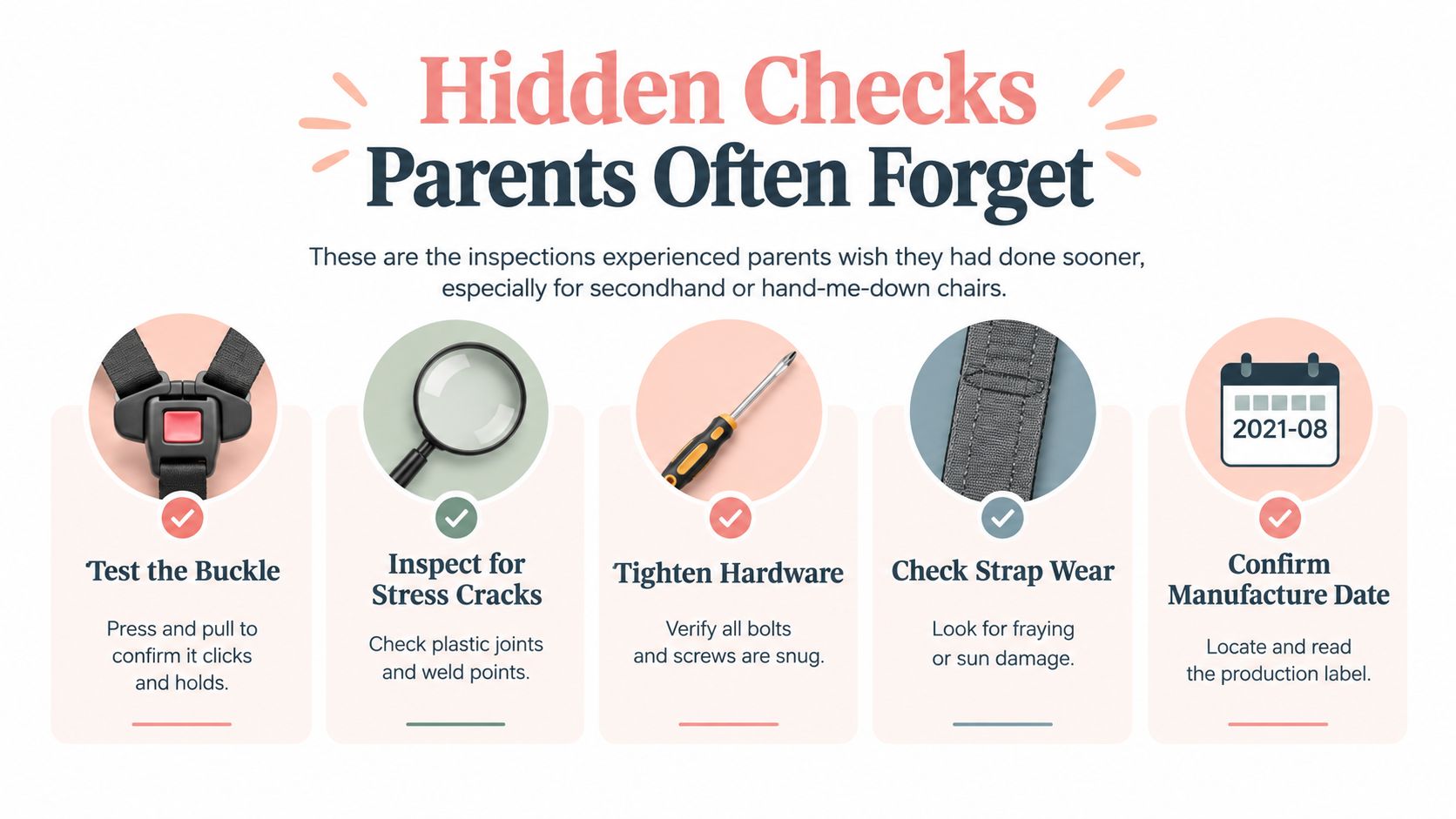
Hidden Checks Parents Often Forget
A chair can look nearly new and still have a missing part, worn strap, or compromised joint. This matters most with hand-me-downs and secondhand listings, where the original manual, recall information, and replacement hardware may not travel with the chair.
The latest safety guidance has drawn attention to missing attached crotch restraints and entrapment hazards. That makes a visual inspection more useful than a quick glance at the upholstery. Check the entire restraint path, including the place where the crotch strap attaches to the seat.
Run the three-minute inspection
Before a child sits in the chair, work through this routine:
- Test the buckle. Click it closed, pull firmly on each strap, and confirm it stays engaged. Release it using the normal adult mechanism.
- Inspect stress points. Look closely at the crotch-post area, plastic joints, weld points, tray mounts, and folding hinges.
- Tighten the hardware. Check every visible bolt, screw, and leg connection. Don't use the chair if a part spins freely, is missing, or won't tighten.
- Check strap wear. Look for fraying, thinning, stiff sections, loose stitching, or damage from sunlight and cleaning.
- Confirm the manufacture date. Find the production label and compare the chair's date with current federal requirements and available safety information.
Don't improvise missing safety parts
A missing tray insert may be an inconvenience. A missing crotch restraint, damaged buckle, or improvised strap is a reason to stop. Ask whether the manufacturer still makes replacement parts for the model. If you can't verify the correct component or the chair has damage around a restraint anchor, choose another chair.
Older chairs deserve extra scrutiny because safety requirements change and recalled models can continue circulating through garage sales and family networks. Check the production label, search the official recall database, and keep the chair away from walls and counters during use. A chair that looks clean isn't necessarily structurally sound.
The right question isn't “Does it look fine?” It's “Can I verify every part that keeps my child seated and the frame stable?”
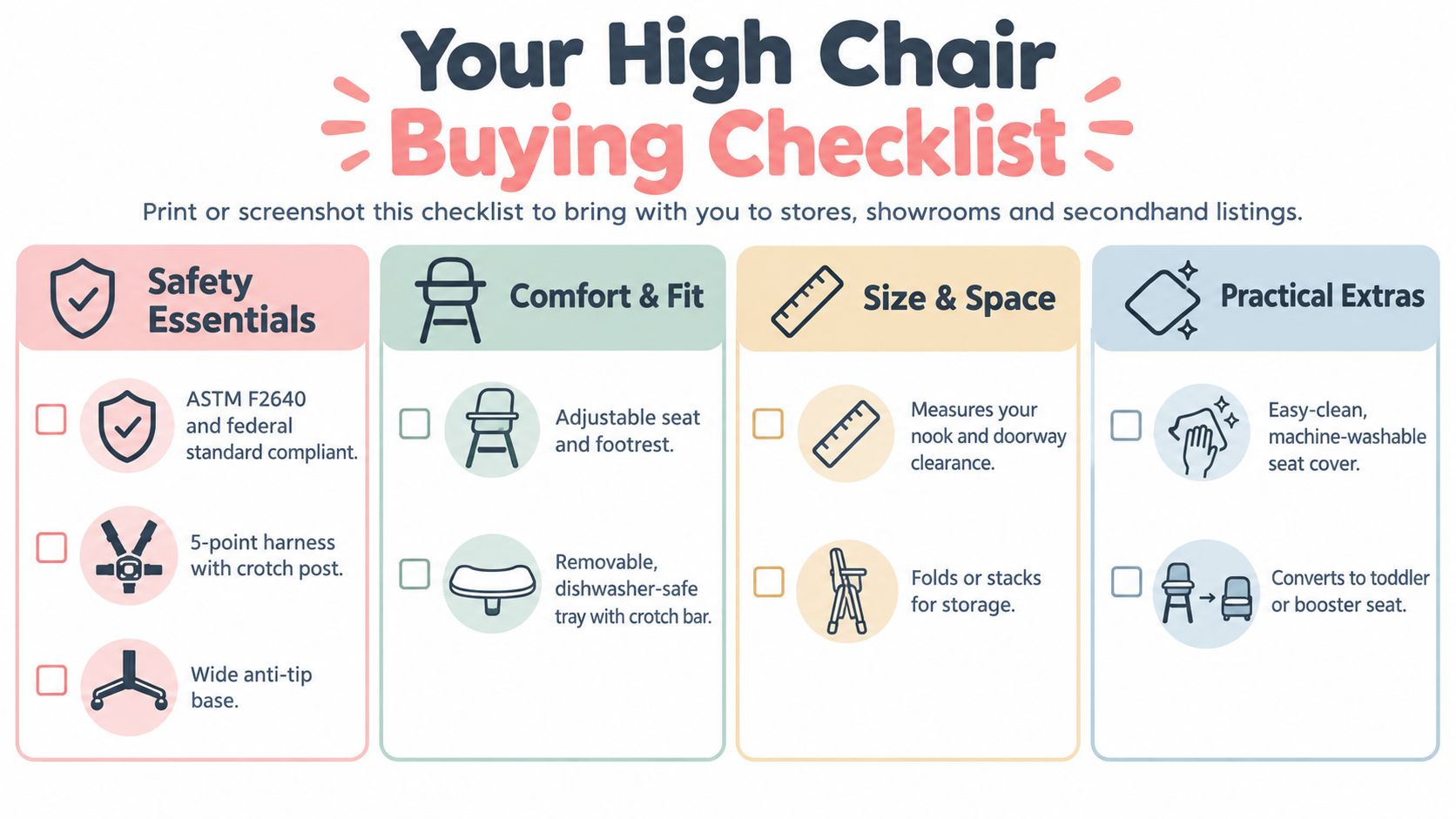
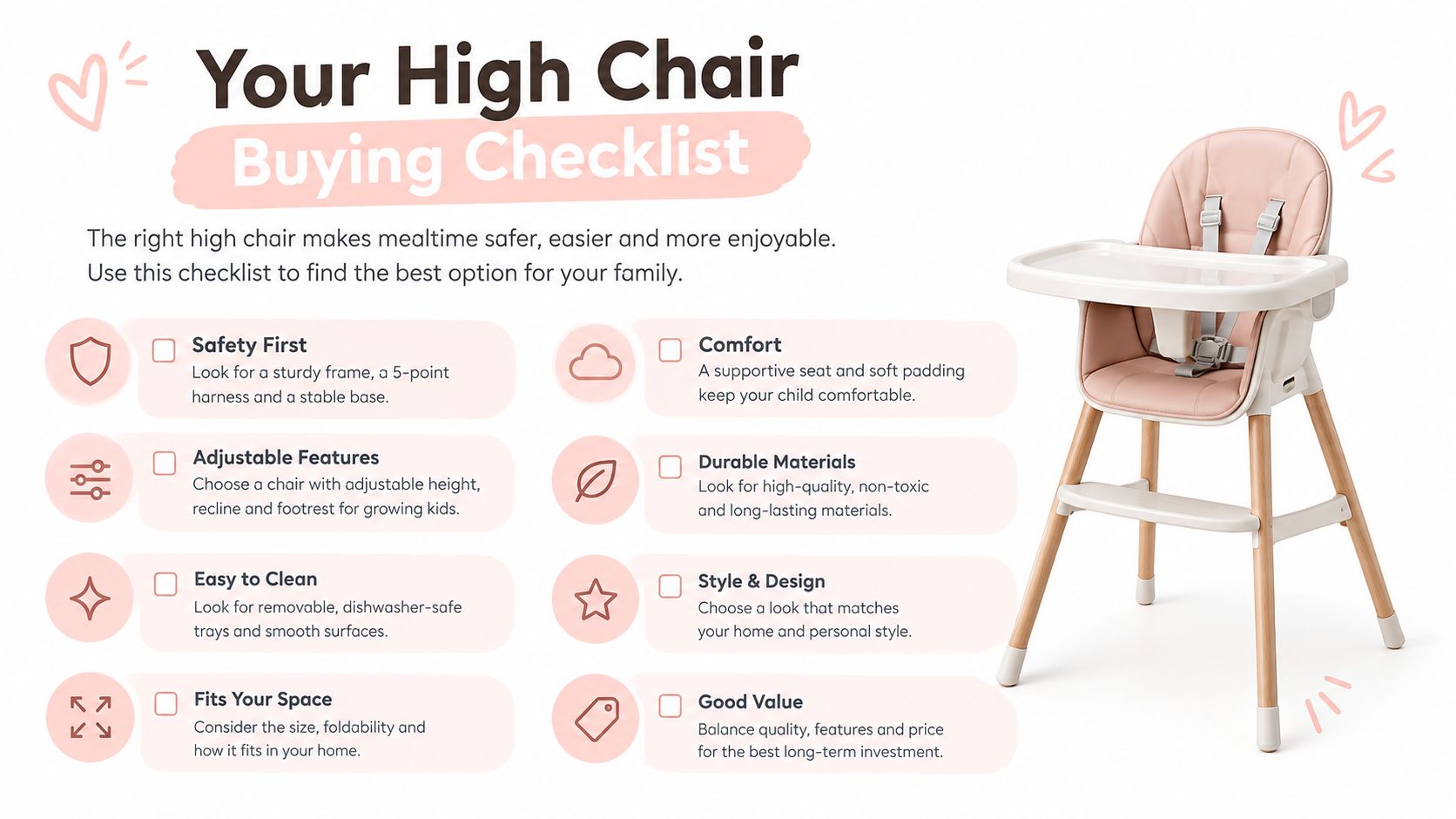
Your High Chair Buying Checklist
Take this list to a showroom, save it beside a secondhand listing, or use it while unpacking a new chair. Start with the features that protect your child, then assess the details that determine whether you'll enjoy using the chair every day.
Safety essentials
- Current compliance: Look for clear information about the applicable federal standard and ASTM F404-21 for U.S. high chairs.
- Complete restraint: Choose a properly attached harness with a passive crotch restraint. A five-point design is my preference for a younger baby.
- Stable base: Push the empty chair from several angles and inspect whether the feet, wheels, locks, and joints stay firm.
- Clear surroundings: Plan to place the chair away from walls, counters, and tables that could give a child a secure grip.
- Undamaged structure: Reject cracked plastic, bent metal, loose welds, split wood, and broken tray latches.
Comfort and feeding fit
- Upright support: Look for a seat that keeps your child centered rather than slumped or sliding forward.
- Adjustable footrest: Your child should be able to rest the feet on a firm support as they grow.
- Useful tray position: The tray should come close enough for comfortable reaching without pressing against the body.
- Removable cleaning surface: A tray that comes off easily and is dishwasher-safe can save repeated hand scrubbing.
- Accessible harness: You should be able to fasten and release it correctly without forcing the buckle.
Home fit and longevity
- Measured footprint: Check full width, depth, doorway clearance, and storage space before ordering.
- Storage method: Decide whether you need folding legs, wheels, stacking, or a permanent table-side position.
- Conversion path: Confirm exactly how the chair changes into toddler or booster modes and whether each mode retains foot support.
- Daily maintenance: Inspect fabric removal, machine-washable covers, strap cleaning, and crevice access.
- Secondhand verification: Record the manufacture date, inspect every screw and strap, and check recall history before use.
Your must-haves should reflect your home and feeding routine. A family with little storage may prioritize folding and easy movement. A family that wants shared table meals may care more about seat height, footrest adjustment, and a tray that comes away cleanly. Read the manual, measure the dining area, and compare the specifications of at least three chairs before purchasing rather than relying on photographs alone.
For a practical mealtime add-on that pairs with a feeding setup, browse the first foods set once you've chosen the chair itself.
NINI and LOLI offers curated baby gear and feeding essentials for families preparing for everyday mealtimes, including high-chair-related products and practical accessories. Visit NINI and LOLI to shop with your measurements, safety checklist, and cleanup routine in mind, then choose the setup that fits your family best.