


Nearly half of car seats have a major misuse error, so the most useful car seat accessories for babies are the ones that support correct installation and harness use rather than alter the restraint. NHTSA estimated that 46% of car seats and booster seats had at least one major misuse capable of reducing crash protection.
You may be choosing accessories while juggling a newborn, a winter coat, a packed changing bag, and a car seat that needs to move between vehicles. A mirror or organizer can make daily travel easier, but an insert, padded cover, or head support can change how the harness fits. The practical question is simple: does the accessory sit in the vehicle, or does it touch the child-restraint system?
Use that question before you buy. If you're shopping for car seat accessories for babies, start with items that improve organization, visibility, or caregiver understanding without changing the seat's tested configuration. Browse car seat accessories for practical options, then check every restraint-touching item against the manufacturer's instructions.
Why Car Seat Accessories Deserve a Safety Check First
Rushed installations are common in family life. You may move the seat after a relative gives you a lift, reinstall it after cleaning the car, or tighten the harness while trying to leave for daycare. An accessory that seemed harmless at home can become a new variable once the seat is reclined, buckled, or moved into another vehicle.
NHTSA's National Child Restraint Use Special Study found that 46% of observed car seats and booster seats had at least one major misuse. A more detailed analysis of 3,383 complete observations found 1,866 cases, or 49% after weighting, with at least one misuse. The documented problems included loose harnesses, straps routed behind the child, and poor installation. NHTSA's child-restraint study shows why a small change in fit deserves attention.
Start with the physical relationship
Before considering color, softness, or convenience, place the accessory into one of these groups:
- Vehicle-only items: Seat-back organizers, storage pockets, and some travel bags attach to the vehicle or carry gear separately.
- Restraint-adjacent items: Mirrors, cup holders, and some covers may be near the seat but should never obstruct installation or visibility.
- Restraint modifiers: Inserts, head supports, harness covers, thick liners, and bunting products sit under, behind, or around the child and require specific approval.
The closer an item gets to the child, harness, buckle, shell, or belt path, the more carefully you need to verify it.
Practical rule: An accessory should make correct use easier, not create another fitting decision during every ride.
A storage organizer can help keep wipes and spare clothing within reach. It can't compensate for a loose installation. A mirror may help a caregiver see a rear-facing baby, but it should never encourage reaching back, distract the driver, or interfere with the seat's position.
For a calm starting point, review these car seat safety tips for infants, then make your accessory list around the routines that happen in your household. The goal isn't a perfectly coordinated back seat. It's a seat that stays correctly installed and a harness that stays snug every time.
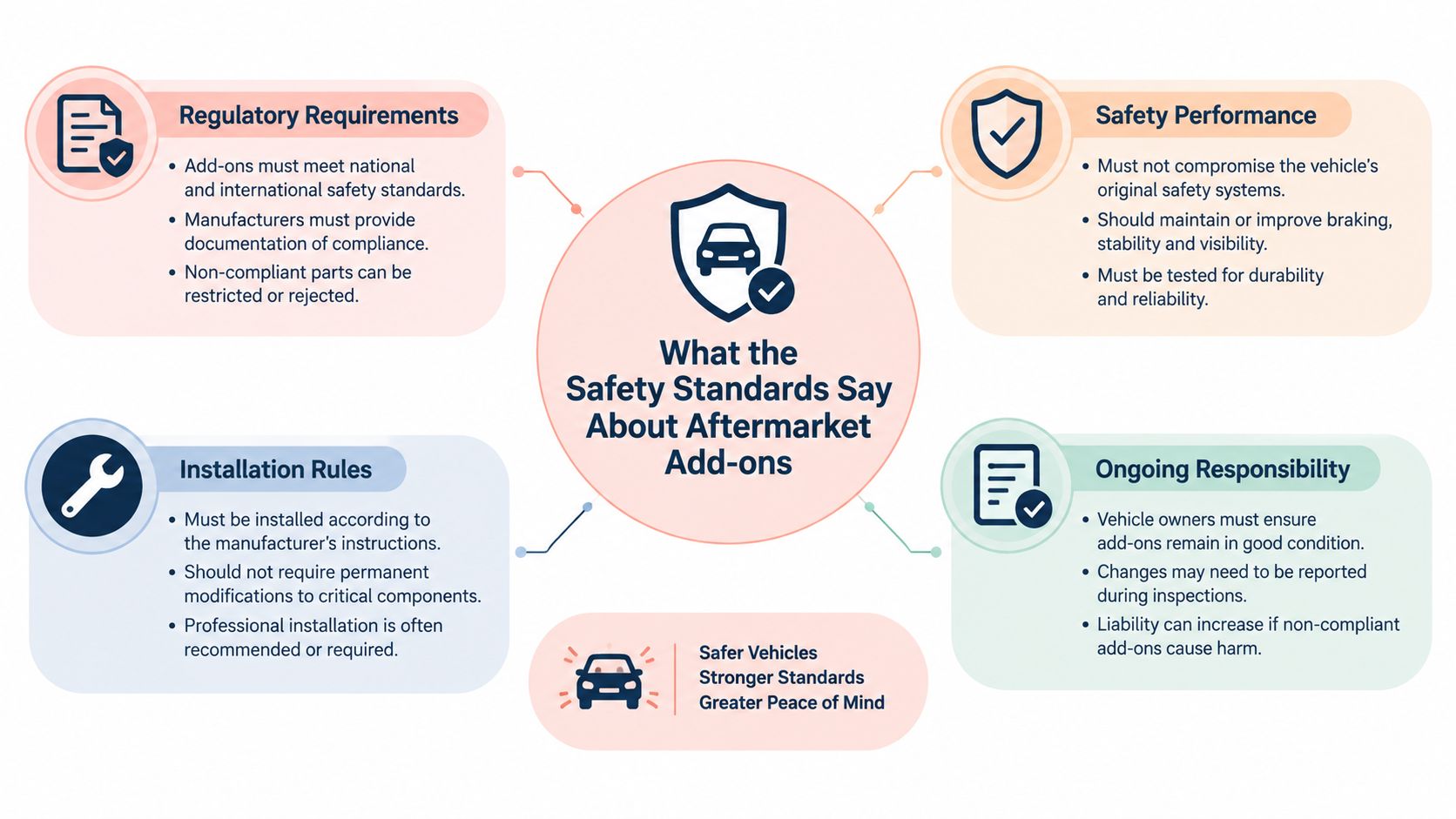
What the Safety Standards Say About Aftermarket Add-ons
Federal safety standards apply to the child-restraint system, not automatically to every item sold beside it. In the United States, separately purchased infant inserts, harness covers, head supports, bunting bags, seat protectors, and warming products are generally treated as aftermarket items. NHTSA advises using an aftermarket product only when the original restraint manufacturer specifically makes or permits it for that seat. NHTSA's car-seat glossary explains why a general “universal” label isn't enough.
The concern is geometric, not merely cosmetic. Soft padding can compress during a crash, creating extra space between the child and harness. An insert can also change harness positioning, the recline angle, or how the restraint contacts the vehicle. Those changes may move the seat away from the configuration the manufacturer tested.
Regulated attachment points are different
The history of modern car-seat accessories is closely connected to LATCH, or Lower Anchors and Tethers for Children. Federal Motor Vehicle Safety Standard No. 225 became fully effective on September 1, 2002, after which new passenger vehicles were required to provide LATCH hardware in designated rear seating positions. Compatible restraints could connect through lower anchors and top tethers rather than relying only on seat belts. NHTSA's LATCH publication distinguishes engineered restraint components from convenience products added after purchase.
That distinction matters because federally regulated attachment points are part of the vehicle and restraint system. A storage pocket doesn't become a safety component just because it sits near a lower anchor. Likewise, an accessory with a “crash-tested” marketing phrase isn't automatically approved for your exact seat.
In one cited survey, top-tether use appeared in only 56% of forward-facing restraints in 2012. Among caregivers who didn't use the tether, 22% didn't know it was present and 15% didn't know how to use it. Loose installation was later identified as the most common forward-facing misuse, affecting 47% of misuse cases, followed by harness slack at 28%, as reported in the same NHTSA publication.
The buying lesson is straightforward: choose convenience products that leave lower anchors, top tethers, harness geometry, and belt paths alone. If an accessory changes any of those areas, pause and look for written model-specific approval.
Vehicle Organizers Versus Restraint Modifiers
A seat-back organizer and an infant insert may both appear on a baby-gear shopping list, but they do very different jobs. The organizer stores diapers, snacks, or spare clothes in the vehicle. The insert changes the space between the child and the restraint.
That difference creates a useful purchasing filter. Vehicle-organizing accessories generally pose fewer fit questions when they attach away from the restraint, while products that sit under or around the child require approval for the exact car-seat model.
| Accessory type | Where it sits | Risk level | Verification needed |
|---|---|---|---|
| Seat-back organizer | On the vehicle seat back | Lower, if it doesn't affect the restraint | Check that it doesn't interfere with the car seat or vehicle seat belt |
| Travel organizer or bag | In the vehicle or carried separately | Lower, when it stays clear of the restraint | Check storage position and loading routine |
| Cup holder | On or near the restraint | Variable | Confirm the seat manufacturer permits it |
| Infant insert | Under or behind the child | Higher | Written approval for the exact seat model |
| Harness cover | Around or beneath harness webbing | Higher | Confirm it doesn't alter strap fit or routing |
| Head support | Around the child's head or body | Higher | Check the seat manual and manufacturer documentation |
| Bunting bag or warming product | Around or beneath the harness | Higher | Use only if specifically approved |
Why “universal” can be confusing
“Universal” usually describes a claimed fit across products. It doesn't prove that the accessory was tested with your particular restraint, baby's position, harness slots, buckle, and recline setting. A product can attach neatly and still create slack or shift a strap.
That's why a seat-back organizer may be a practical choice for a family managing daycare supplies, while a soft insert for a newborn should remain in the shopping cart until the manufacturer confirms approval. The two products may look equally convenient, but only one stays physically separate from the harness.
Parents considering inserts should also review this guide to infant car-seat inserts. Use it as a prompt to check the exact model documentation, not as a substitute for the seat manual.
A simple decision question
Ask where the product sits during travel:
- In the trunk or on the vehicle seat back: Usually an organization decision.
- Beside the restraint: Check that it doesn't affect installation, visibility, or stability.
- Under the child or behind the back: Treat it as a restraint modification.
- Under, around, or across harness webbing: Require explicit manufacturer approval.
- Near the buckle or belt path: Don't purchase until compatibility is confirmed.
This approach keeps the focus on physical interaction rather than attractive packaging.
Risks of Car Seat Covers, Pads, and Winter Gear
On a cold morning, a parent may reach for a padded cover, settle a baby into the seat, and tighten the harness as usual. The cover may look harmless, yet its position determines whether it only protects the child from the weather or changes how the restraint works.
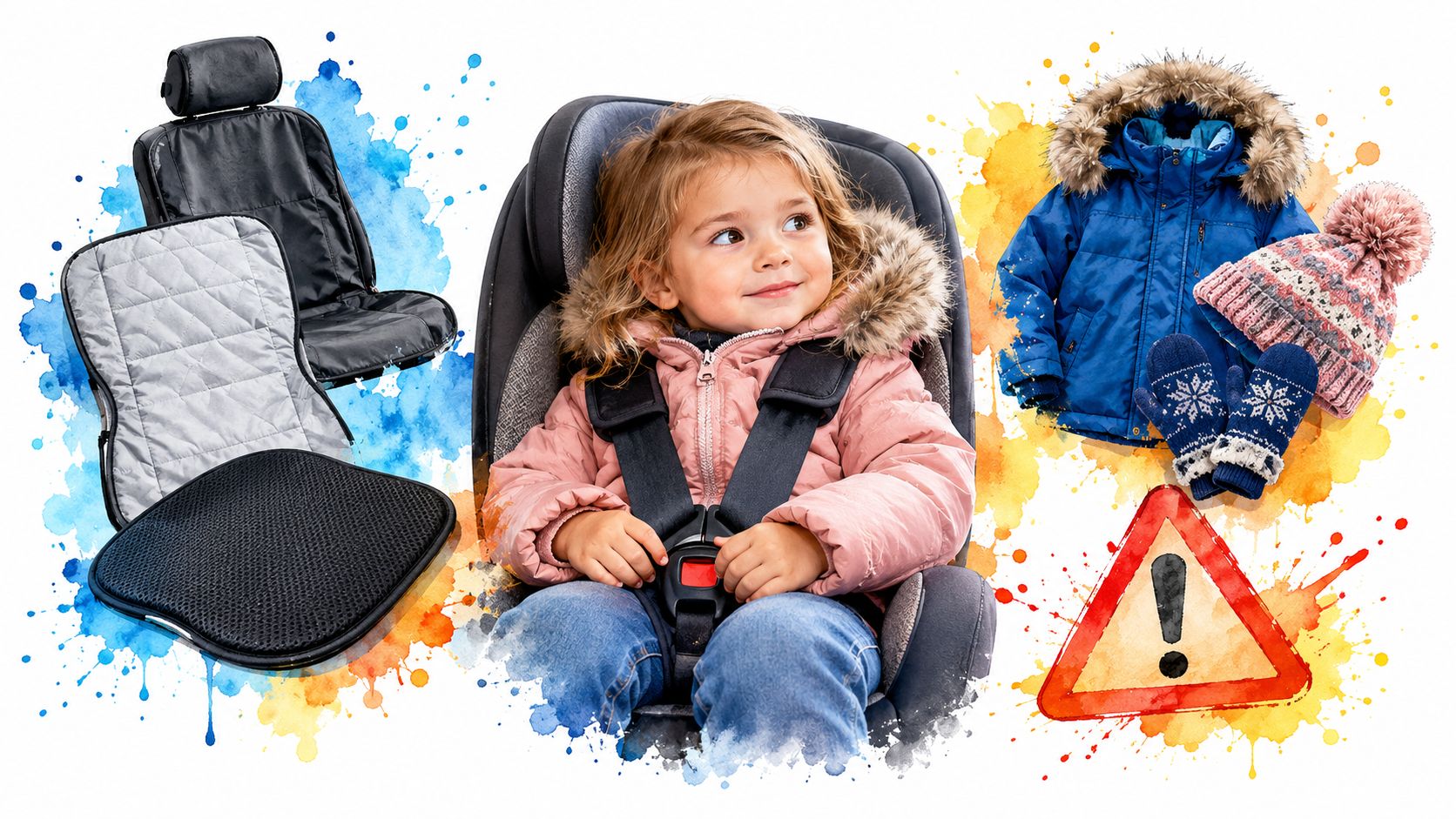
Accessories outside the restraint, such as a cover over the seat or an organizer attached to the vehicle, have a different safety question from items placed under the child. Material between the child and harness can compress during a crash, increasing the space the harness must control. NHTSA's interpretation on child-seat covers explains why softness alone does not make a product suitable.
Keep the harness path clear
A cover that stays outside the child-restraint system can be easier to assess. It should remain thin around the seat and leave these areas unchanged:
- Obstruct harness slots: Straps must follow the routing shown in the manual.
- Change buckle position: The crotch buckle must remain accessible and correctly positioned.
- Alter shoulder-belt height: Added fabric should not lift, redirect, or cover the harness.
- Interfere with the shell or belt path: The restraint must contact the vehicle as designed.
- Create hidden slack: Padding beneath the child can compress under crash loading.
The physical relationship matters more than a product's label. NHTSA states that FMVSS 213 applies to the restraint system itself, while a separately sold cover may fall outside that standard. NHTSA's guidance on covers and aftermarket materials directs attention to placement, padding, and interaction with the restraint.
Dress for the harness, then add warmth
A thick coat or snowsuit under the harness can stop the straps from tightening closely against the child. Dress the baby in ordinary indoor layers, buckle the harness snugly, and place a blanket over the secured straps. Another option is to put the coat on backward over the buckled harness.
Montgomery County's guidance recommends checking the fit after buckling. The harness should be tight enough that you cannot pinch the straps between your fingers. The winter car-seat guidance supports using a blanket or approved cover instead of thick material beneath the harness.
Families using a Doona can also review when kids can safely sleep with a Doona car seat and age guidelines before treating a car seat as a place for rest outside travel.
For a warm home to cold daycare trip, repeat the same order: secure the child first, add warmth second, and remove extra layers before checking the harness again.
How to Verify Accessory Approval for Your Car Seat Model
A product page may say “fits most seats,” but your decision needs more detail. Approval should relate to the exact car-seat model, the way you're installing it, and the accessory's position during travel.
Use this routine before purchasing an item that touches the child or restraint.
Check the seat manual first
Search the manual for terms such as approved accessories, insert, cover, harness pad, crotch buckle, seat protector, or installation. Look for a direct statement about whether the accessory is supplied with the seat, available from the manufacturer, or permitted for that model.
If the manual says nothing, don't treat silence as approval. Contact the manufacturer and ask about the exact model name, model number, accessory, and installation configuration.
Separate vehicle compatibility from seat approval
An adapter may connect a compatible infant car seat to a stroller, but that doesn't mean an insert or cover is approved for use inside the restraint. A vehicle mat may fit the seating area, but you still need to check whether it changes stability or installation.
Write down the answers before buying:
- Does the accessory touch the child, harness, buckle, shell, or belt path?
- Does the manufacturer approve it for this exact model?
- Does approval apply to the rear-facing or forward-facing configuration you use?
- Will it change harness routing, recline angle, or belt tension?
- Can you remove it without changing the installation?
Look for model-specific language
A generic claim that an item is “safe for infants” isn't the same as written approval. The strongest purchase signal is documentation that names the specific restraint or comes directly from its manufacturer.
For families building a travel system, car-seat adapter options still deserve this same check. Confirm that the adapter is intended for the infant seat and stroller combination you plan to use, then follow both product manuals.
If you can't verify the accessory, choose an item that stays away from the restraint. That isn't an overreaction. It's a simple way to reduce uncertainty while preserving the original fit.
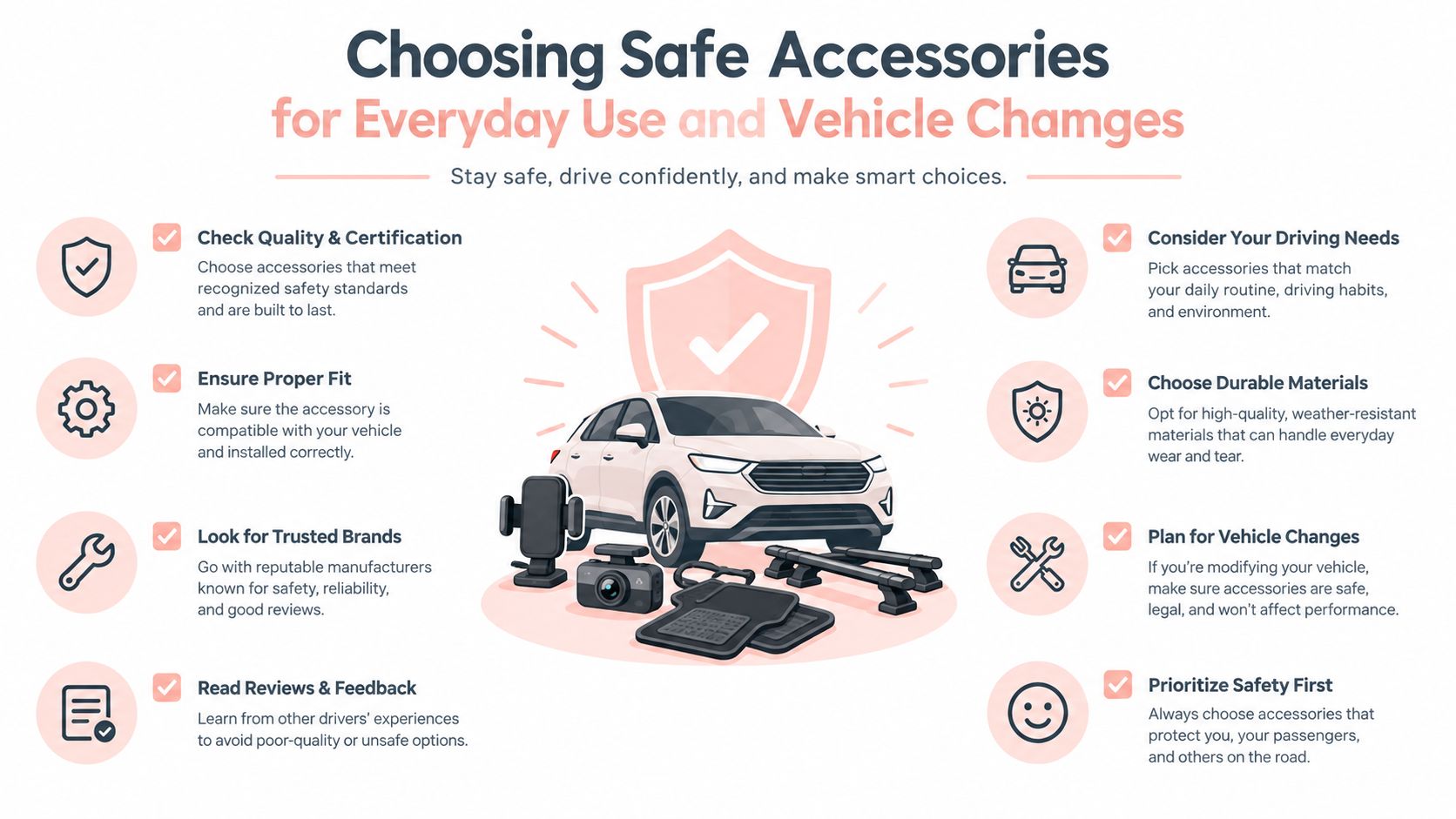
Choosing Safe Accessories for Everyday Use and Vehicle Changes
Accessories need to work with real routines, not just a single driveway installation. Families may alternate between cars, share the seat with grandparents, use taxis, or remove storage gear before a trip. Each change is a reason to repeat the installation and harness check.
NHTSA recommends following both the child-restraint and vehicle manuals, using either lower anchors or the seat belt rather than both, and using the top tether for forward-facing installation when permitted. CDC guidance says the installed seat should move no more than 1 inch side-to-side or front-to-back and that LATCH weight limits should be checked in both manuals. NHTSA's car-seat guidance provides the core installation framework.
Before handing the seat to another caregiver, keep the routine consistent:
- Recheck the belt path: Remove any organizer or mat that blocks access.
- Confirm the installation method: Don't switch between anchors and the seat belt casually.
- Check the harness: Tighten it against the child, with no bulky clothing beneath.
- Review the tether: Use it for forward-facing installation when the manuals permit it.
- Test stability: Check movement at the belt path after any vehicle change.
- Keep accessories predictable: Store mirrors, toys, and bags where they won't affect the seat.
For a longer journey, a toy can support engagement when it's approved and positioned as directed. Review these car-seat toy ideas for travel, then keep the restraint itself free from unapproved additions.
The right purchase is usually the accessory that makes your routine simpler without asking the harness to do a different job. Choose organization for the vehicle, verify anything that touches the restraint, and make installation the first check after every move.
NINI and LOLI offers curated baby gear, including car-seat adapters and travel accessories, to help families organize everyday outings while keeping restraint compatibility in focus. Visit NINI and LOLI to explore practical options for newborn travel and choose accessories that fit your family's routine.